You can also see a video of this blade at http://www.youtube.com/watch?v=AFyUlvqDcD4
Wednesday, July 18, 2012
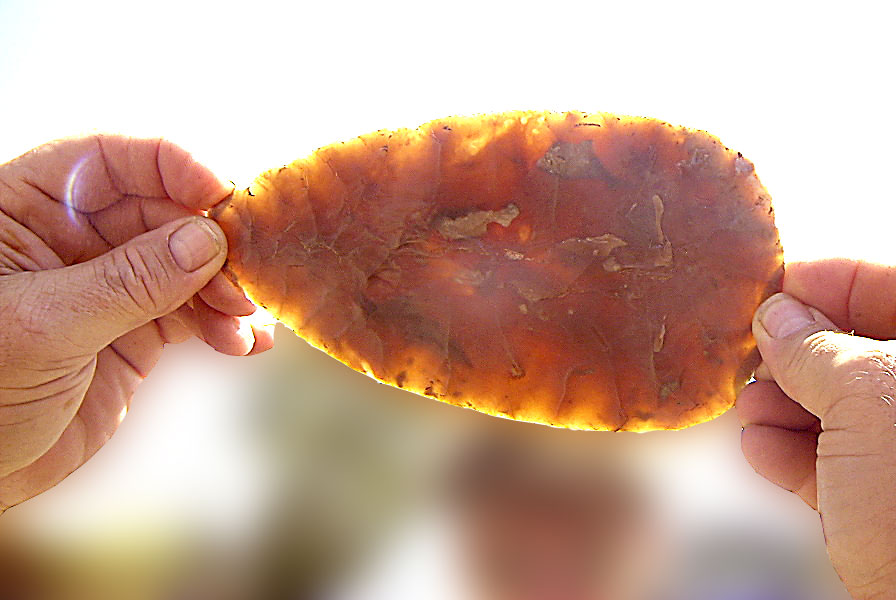
Type 1C Danish Dagger
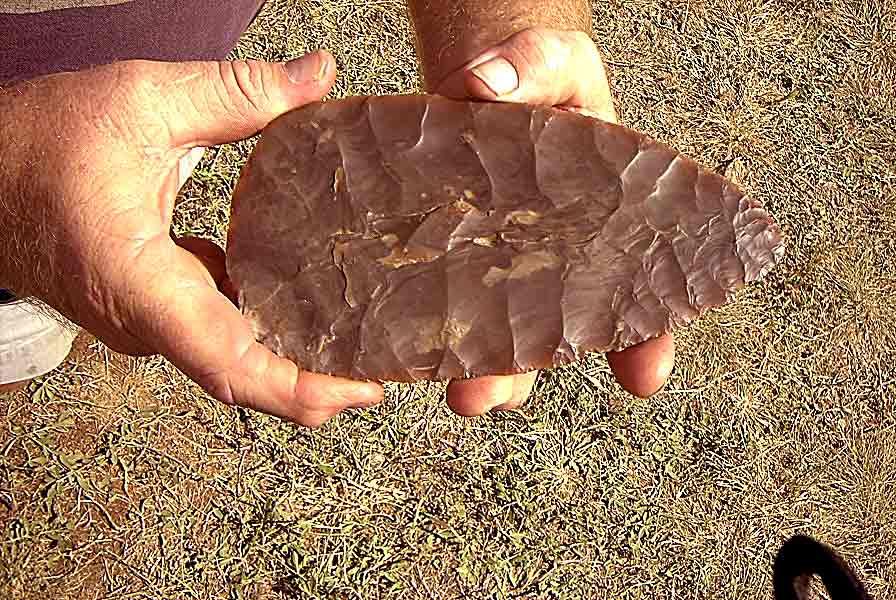
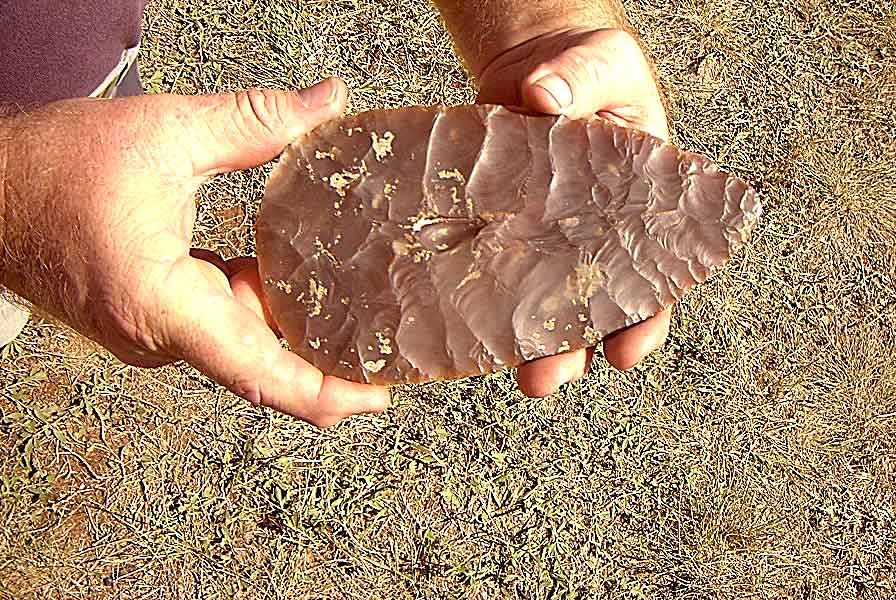
Back in 2009 I posted about Greg Nunn's Edge to Edge flaking. After viewing Greg's video Bill also made some edge to edge pieces at that time.Since then Bill made a Type 1C Danish dagger with edge to edge flaking, below is a picture. This blade is around 7 inches long.
You can also see a video of this blade at http://www.youtube.com/watch?v=AFyUlvqDcD4
Sunday, April 15, 2012
Possible Evidence the Sweetwater blade was ground
In our original article about our theory on how the SWB was made we mentioned that it was possibly ground prior to the flaking. We believe we have found some flat spots or "islands" on the cast as further evidence that the blade was ground prior to it being flaked.
Below are some pictures of the SWB cast. If you look closely at the cast with a magnifying glass you can see some flat places or "islands" on both faces of the blade. These islands are where the flakes did not run entirely across the face of the blade which left these flat spot islands. We have circled these spots on the cast so anyone who has a cast can find them easily as well.
On the top side of the divot(top side in reference to the picture here) you can also see small scars that appear to show where an island was pried out to form the divot.
Is it possible that the blade laying in the ground for 500 years rubbed these flat spots? That is possible, but if so, why didn't the entire blade rub flat?
This is the same method(ground then flaked) we used to make our SWB replica which has an average thickness of .22 inches compared to the cast which has an average of .17 inches. Below is a side view picture of our replica next to the cast.
For reference, we will call the side WITHOUT the divot as Side 1, which is the top picture. On side 1 we have circled 3 spots where the flat spot islands are located.
Below is the picture I mentioned above comparing the SWB replica to the SWB cast.
Below are some pictures of the SWB cast. If you look closely at the cast with a magnifying glass you can see some flat places or "islands" on both faces of the blade. These islands are where the flakes did not run entirely across the face of the blade which left these flat spot islands. We have circled these spots on the cast so anyone who has a cast can find them easily as well.
On the top side of the divot(top side in reference to the picture here) you can also see small scars that appear to show where an island was pried out to form the divot.
Is it possible that the blade laying in the ground for 500 years rubbed these flat spots? That is possible, but if so, why didn't the entire blade rub flat?
This is the same method(ground then flaked) we used to make our SWB replica which has an average thickness of .22 inches compared to the cast which has an average of .17 inches. Below is a side view picture of our replica next to the cast.
For reference, we will call the side WITHOUT the divot as Side 1, which is the top picture. On side 1 we have circled 3 spots where the flat spot islands are located.
Below is Side 2 which is the side the divot is on, the divot is actually circled and is the middle circle or the second from the left. So Side 2 has two flat spot islands on it which are also circled.
Below is the picture I mentioned above comparing the SWB replica to the SWB cast.
Sunday, March 11, 2012
Interview with Daniel Pierce
Please visit http://www.modern-flintknappers.com/featured-knappers to see our recent interview with flintknapper Daniel Pierce.
Also check out Daniel's site at http://danielapierce.deviantart.com/gallery/#/d4s6c60
Sunday, February 26, 2012
Boy Scouts Demo
We had a very good time yesterday doing a demo for the local Boy Scouts. There are couple videos of it at the video page at www.modern-flintknapper.com or you can also see them at our YouTube channel BillEarnhardtknapin. They are basic videos for beginners but Part 1 does show percussion fluting and Part 2 covers some dorsal ridge abrading.
Sunday, January 29, 2012
Wednesday, January 4, 2012
Bell-Locksburg Blade
I just became aware of this blade. It looks similar to the Sweetwater. You can learn more about it at http://www.arrowheads.com/flint-projectiles-and-knives/413-the-bell-locksburg-blade
Walnut Creek Pictures
I mentioned the Walnut Creek Biface in my "Got Convex" article but just realized I don't have any pictures of it on here. You can read more about it at http://www.stoneage1.com/knap/walnut.html
and http://www.dirtbrothers.org/ashley/ashleyarticle.html
Here are a few pictures of it.


and http://www.dirtbrothers.org/ashley/ashleyarticle.html
Here are a few pictures of it.
Subscribe to:
Posts (Atom)